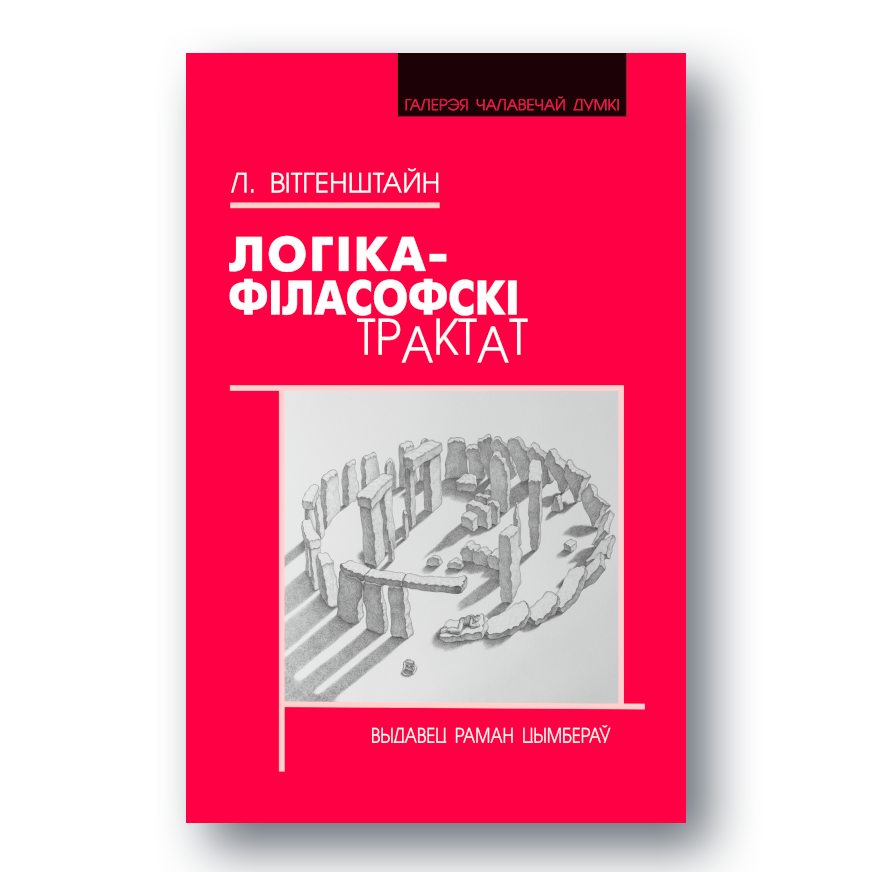

Tsymberau
Logical-Philosophical Treatise
Logical-Philosophical Treatise
Аўтар: Ludwig Wittgenstein
Рэкамендацыя ўзросту: 12+
Low stock: 4 left
Couldn't load pickup availability
Мова: Belarusian
Старонак: 118
Год выдання: 2025
Месца выдання: Minsk
Вокладка: soft
Фармат: 13x20 cm
ISBN: 978-985-7334-18-6
Ludwig Wittgenstein's book "Tractatus Logico-Philosophicus" is a fundamental text in 20th-century philosophy that laid the groundwork for logical positivism and became the basis of the work of the Vienna Circle. Here, the author explores the limits of language and thought, asserting that everything expressible must be clear, and what cannot be said must be passed over in silence. The Belarusian edition includes a preface by Bertrand Russell and special German-Belarusian and English-Belarusian glossaries, making this complex work more accessible to the contemporary reader.
***
Ludwig Wittgenstein (1889–1951) — an Austrian-British philosopher who, having published essentially only one work, "Tractatus Logico-Philosophicus," during his lifetime, had a decisive influence on 20th-century philosophical thought, primarily on the philosophy of logical positivism and the activities of the so-called Vienna Circle. The preface by the famous logician, mathematician, and philosopher Bertrand Russell to the first edition of this work is published here as an afterword.
CONTENTS
Tractatus Logico-Philosophicus
Explanation of Symbols
Ludwig Wittgenstein. A Short Biography
Bertrand Russell. Introduction to "Tractatus Logico-Philosophicus"
German-Belarusian Glossary to L. Wittgenstein's Work
English-Belarusian Glossary to B. Russell's "Introduction."
PREFACE
This book will perhaps only be understood by those who have themselves already thought the thoughts which are expressed in it—or at least similar thoughts... Thus it is not a textbook. Its object would be attained if there were one person who read it with understanding and enjoyed it.
The book deals with the problems of philosophy, and shows, as I believe, that the reason why these problems are posed is that the logic of our language is misunderstood. The whole meaning of the book could be summarized as follows: whatever can be said at all can be said clearly, and what cannot be said we must pass over in silence.
Thus the aim of the book is to draw a limit to thought, or rather—not to thought, but to the expression of thoughts: for in order to be able to draw a limit to thought, we should have to find both sides of the limit thinkable (i.e. we should have to be able to think what cannot be thought).
It will therefore only be in language that the limit can be drawn, and what lies on the other side of the limit will be simply nonsense.
I do not wish to judge how far my efforts coincide with those of other philosophers. Indeed, what I have written makes no claim to novelty in points of detail, and for this reason I give no sources, because it is indifferent to me whether what I have thought has already been thought by someone else before me.
I will only mention that to the great works of Frege and the writings of my friend Bertrand Russell I owe in large measure the stimulation of my thoughts.
If this work has any value, it consists in two things. First, it expresses thoughts, and the greater the value, the better the thoughts are expressed, and the more accurately they hit the mark. I am conscious that I have fallen far short of what is possible. Simply because I lack the power to cope with the task... Let others come and do it better.
Yet the truth of the thoughts communicated here seems to me unassailable and definitive. So, I believe that the problems dealt with in this work have been solved in essence. And if I am not mistaken, then secondly, the value of this work is that it shows how little has been done when these problems have been solved.
L. W.
Vienna, 1918